The OnePlus Nord 2T 5G is a four-year-old mid-ranger that still feels competent for daily tasks, but software support has ended and newer phones offer better longevity for similar money. If you find a clean used or refurbished unit well under ₹18,000, it can work as a short-term budget phone. Paying closer to original launch prices no longer makes sense.
Launched in India in mid-2022 at ₹28,999 for the 8GB + 128GB model and ₹33,999 for the 12GB + 256GB variant, the Nord 2T was a minor refresh of the Nord 2. It kept the same camera and display while switching to the MediaTek Dimensity 1300 and raising charging speed to 80W. In 2026 the phone sits firmly in the used and residual-stock market. Many listings show it out of stock or hovering around the mid-₹20,000s when available; refurbished units drop lower. That price context shapes every recommendation below.
Design, Display and Everyday Feel
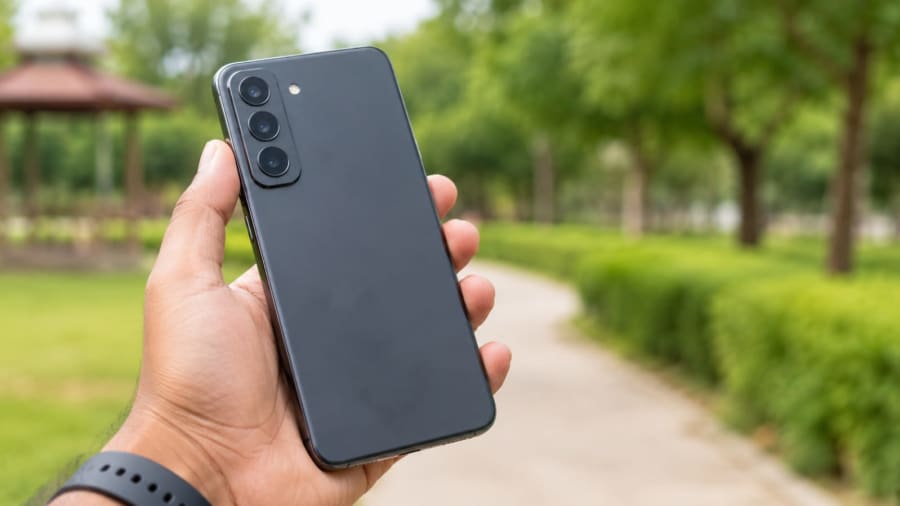
The Nord 2T measures 159.1 × 73.2 × 8.2 mm and weighs 190 g. The plastic frame and matte back feel solid enough for the class, though the phone has no official IP rating for water or dust. Colours were Gray Shadow and Jade Fog. The in-display fingerprint sensor and alert slider remain useful OnePlus traits.
The 6.43-inch FHD+ AMOLED panel runs at 90 Hz with HDR10+ support and Gorilla Glass 5 protection. Peak brightness is adequate for outdoor use in most Indian conditions, and colours stay vibrant. The 90 Hz refresh rate still feels smooth for scrolling and light gaming. Bezel sizes look dated next to 2025–2026 phones, but the screen itself has not aged badly.
Stereo speakers deliver clear sound at moderate volumes. There is no 3.5 mm headphone jack. The overall package is comfortable in one hand and does not feel cheap, which helped the Nord series build its reputation.
Performance in Daily Use and Light Gaming
The Dimensity 1300 (6 nm) paired with 8 GB or 12 GB LPDDR4X RAM and UFS 3.1 storage handles everyday multitasking without drama. App launches, social media, browsing and video streaming remain smooth. Storage is not expandable, so the 128 GB base model fills up faster if you keep many photos and offline videos.
Gaming is fine for titles that do not demand flagship hardware. Expect solid frame rates in lighter and mid-range games; heavier titles may need lower settings and the phone can warm up under sustained load. Benchmark numbers from launch put it in the respectable mid-range of 2022. In 2026 those scores look average against current under-₹25,000 chips, but the phone still feels responsive for non-gaming work.
Thermal behaviour is acceptable for short sessions. Prolonged high-load use causes some throttling, a common trait of the Dimensity 1300 era. For most Indian users who mix WhatsApp, YouTube, banking apps and occasional BGMI, the hardware remains usable.
Camera: Still Capable for the Age
The rear setup is identical to the Nord 2: 50 MP Sony IMX766 main sensor with OIS, 8 MP ultrawide, and a 2 MP mono sensor. The main camera is the star. Daylight shots retain good detail, accurate colours and usable dynamic range. Nightscape mode and OIS help in low light, though results are softer than current mid-rangers. The ultrawide is average; the mono sensor adds little practical value.
Video reaches 4K at 30 fps on the main camera. Stabilisation is decent for casual clips. The 32 MP front camera produces clean selfies in good light with some oversharpening on skin tones, typical of the period.
In 2026 the camera is no longer competitive with new phones in the same residual price band that ship larger sensors or better computational photography. It is still good enough for family photos, Instagram and everyday documentation if you are not chasing maximum detail.
The Nord 2T’s real strength was never the absolute best camera or the longest battery. It was the combination of a clean software experience, very fast charging, and a main sensor that punched above its price when the phone was new.
Battery Life and the 80W Advantage
The dual-cell 4500 mAh battery was never the largest in its class, yet real-world endurance is respectable. Mixed use (calls, messaging, browsing, some video) usually delivers a full day. Lighter days stretch into a second day. Heavy gaming or continuous 5G streaming shortens that window.
Where the Nord 2T still shines is charging speed. The 80W SuperVOOC charger (included at launch) fills the battery from empty to full in roughly 27–32 minutes. A 10–15 minute top-up provides several hours of use. That convenience remains rare even among newer budget phones and offsets the modest capacity for many users.
No wireless charging is present, which is expected at this level. Battery health after three or four years of use varies widely depending on charging habits, so any used unit should be checked carefully for capacity degradation.

Software Support Has Ended
This is the decisive drawback in 2026. The phone launched on Android 12 with OxygenOS and received two major upgrades to Android 14. Security updates were promised for three years and largely concluded around mid-2025. Official major OS support is finished. Occasional security patches may still appear in some regions, but you should not count on them.
OxygenOS remains relatively clean and fast compared with many heavily skinned alternatives, yet the lack of ongoing security fixes is a genuine concern for banking, UPI and personal data. Newer phones in the ₹20,000–30,000 range now commonly offer three to four years of OS updates and longer security support. That difference matters more than a 90 Hz display or 80W charging for most buyers planning to keep a phone two or three years.
Custom ROM options for MediaTek devices of this generation are limited, so waiting for community support is not a reliable plan.
Who Should Consider the Nord 2T in 2026?
Buy it only if three conditions are met: the price is clearly lower than new alternatives (ideally under ₹15,000–18,000 for a clean used or refurbished unit), you accept that software updates have stopped, and your needs are basic calls, messaging, light media, occasional photos. It remains a practical short-term device for students, secondary phones, or someone who prioritises fast charging over future-proofing.
Skip it if you want longer software support, better low-light cameras, larger batteries, or higher sustained performance. Current options around the same residual prices usually deliver more modern chips, 120 Hz displays, 5000 mAh-plus batteries and active update policies. For a broader look at phones that still make sense under tighter budgets, see more guides on the site.
Aspect | Nord 2T 5G (2022) | Typical 2025–26 Budget Alternative |
|---|---|---|
Software support | Ended (Android 14 final) | 2–4 years OS + longer security |
Battery | 4500 mAh, excellent 80W charge | 5000–7000 mAh, slower charge common |
Display | 6.43" 90 Hz AMOLED | Often 6.6–6.7" 120 Hz |
Main camera | 50 MP OIS, still usable | Larger sensors or better processing |
Best price point now | Under ₹18,000 used | New devices from ₹15,000–25,000 |
The Nord 2T was a sensible phone when it launched. Four years later its strengths fast charging, a decent main camera, and clean software still exist, but the lack of updates and competition from newer hardware limit its appeal. Treat it as a temporary or secondary device at the right price, not a primary long-term purchase. Check battery health, seller reputation, and exact configuration before you commit real money. So, as per use may be it's worth buying for someone.